![[personal profile]](https://www.dreamwidth.org/img/silk/identity/user.png) enismirdal
enismirdalSo I proceeded to Hampstead Heath yesterday for yet another unsuccessful hunt for chafer beetles.
However, it wasn't all bad; I had the foresight to bring a camera, and because spring is now in full swing, the Heath had loads of solitary and some social bees!
I post about social bees (mainly bumblebees) a fair amount, but probably unfairly neglect their little solitary cousins. Probably most people don't even notice solitary bees except when they have mining bees making little "volcanoes" in their herb garden, mason bees digging up their walls or carpenter bees eating their roof-beams! But they're also important - in many places very crucial pollinators which filled a lot of niches that are now dominated by domesticated honeybees. They're very peace-loving and very few of them have a sting strong enough to get through human skin, so they're very un-scary. Some are a bit ugly; some are very very cute.
My personal favourite solitary bee is Anthophora plumipes - the females are round and black and busy, while the males are silly and ginger and very territorial, so if you're watching some females foraging (their favourite flowers include the dead-nettle Lamium album) you often find a small ginger thing flying at you in what he perceives to be a threatening manner, but is mostly just cute.
In any case, they're an early-spring species, hitting their peak around March and April. It now being mid-spring, a different selection of bees are around.
OK, so I know remarkably little about solitary bees really, and my ID skills are distinctly patchy. So the identifications below are best-guess only, guided by my Collins Field Guide and the most excellent BWARS website.
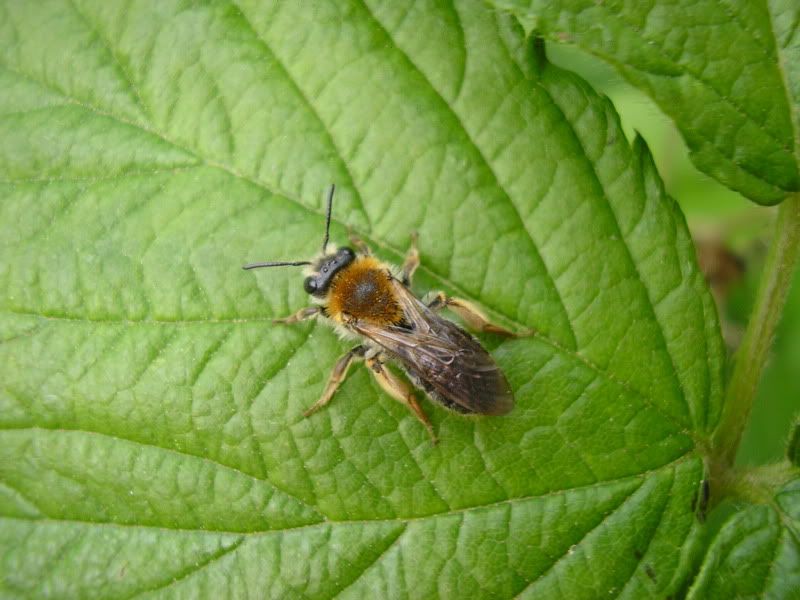
This one, I think, is Andrena florea. Andrena species are quite common in Europe generally and nest in little holes in the ground (Andrena fulva, the Tawny Mining Bee, is very common and found in gardens all over the UK and presumably much of Europe too. The female A. florea apparently only collects pollen from white bryony, which I didn't see, but I'm sure there was some somewhere!

Another Andrena, this one, I think, Andrena haemorrhoa or Andrena flavipes, and almost certainly a female. They like blackthorn, among other things. Another photo here

This may be an Andrena, but could be either a Eucera or a Colletes or some variety (or something else entirely!).

I'm moderately sure this is a Halictus tumulorum or some kind of Lasioglossum. Halictus species are also ground-nesting

I think this is some species of Lasioglossum - yet another ground-nesting species, related to Halictus.

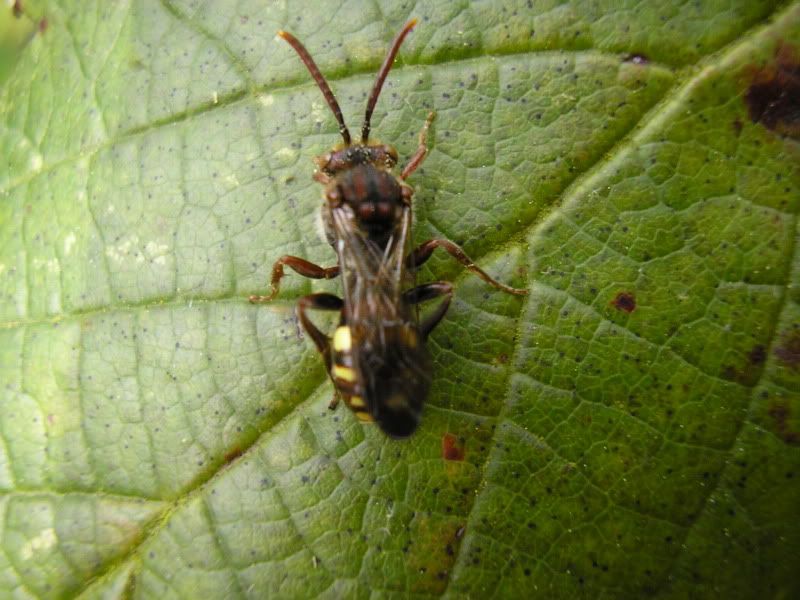
A fun one - Nomada, probably Nomada leucopthalma or flava. The Nomada genus consists of cuckoo bees (much like the old genus Psythirus, which they've now decided is part of Bombus). They lay their eggs in the nests of Andrena species, the emerging larvae feeding on the pollen that the the poor, long-suffering mother Andrena left for her own children. It's one of the biggest genera of bees, with over 850 species, a lot of whom look quite wasp-like really. Another photo here.

Not a bee. This is a Rhogogaster, perhaps Rhogogaster genistae. Sawflies are also Hymenoptera, like bees, wasps and ants, but they're a more basal group (i.e. older). Aside from one group, they're vegetarians, and their larvae look a lot like caterpillars. The adults come in some startling colours, like this green dude, but they still have the hymenopteran facial appearance.

A peacock butterfly, just because I stumbled upon it...

The token social bee, probably a Bombus pascuorum queen really, but based on the gingerness of the thorax and the paleness of the abdomen, it's possible that this was actually a Bombus humilis, which is similar but much rarer (but I've seen one in the London area before, so it may be that the populations are recovering in some urban areas - I hope so!).

I actually have no idea what this is! It's definitely a live insect of some variety, as if you go to poke them, they see your finger coming and kind of flutter/scuttle away. If I had to guess, I'd suggest it might be either a bug (Hemiptera) species, or perhaps some kind of micromoth, but that's really just wild speculation. I have utterly failed to find it in my field guide so far. Anyone with any ideas, please let me know! It kind of reminded me of No Face from Spirited Away for some reason!

Lastly, I suppose those of you who haven't been to London will be wondering what Hampstead Heath actually looks like! Well, I forgot to take a lot of landscapey pictures, although it was rather pretty. But when I was sitting down on Parliament Hill, I noticed that it was a reasonably clear day with good views, and so took a shot of the London cityscape. So this is a feeling for the place - large grassy area in zone 2 of huge city.

With a few landmarks labelled...

PS If any of you who live in the UK do happen to come across any Phyllopertha horticola or Hoplia philanthus in the next couple of months, please put them in a little tub or pot (like a film tub, but put some air-holes in) and send them to me! I'll happily refund your postage and provide chocolate or a small cash recompense up until the point where I have enough beetles!
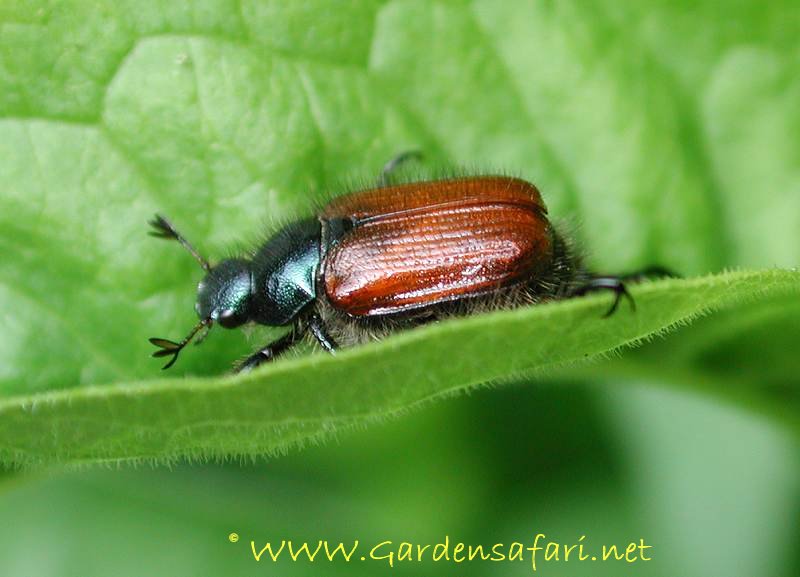
The beetles are about 1cm long and quite chunky, and both species look pretty similar, something like this - that's P. horticola; H. philanthus is a bit less shiny.
However, it wasn't all bad; I had the foresight to bring a camera, and because spring is now in full swing, the Heath had loads of solitary and some social bees!
I post about social bees (mainly bumblebees) a fair amount, but probably unfairly neglect their little solitary cousins. Probably most people don't even notice solitary bees except when they have mining bees making little "volcanoes" in their herb garden, mason bees digging up their walls or carpenter bees eating their roof-beams! But they're also important - in many places very crucial pollinators which filled a lot of niches that are now dominated by domesticated honeybees. They're very peace-loving and very few of them have a sting strong enough to get through human skin, so they're very un-scary. Some are a bit ugly; some are very very cute.
My personal favourite solitary bee is Anthophora plumipes - the females are round and black and busy, while the males are silly and ginger and very territorial, so if you're watching some females foraging (their favourite flowers include the dead-nettle Lamium album) you often find a small ginger thing flying at you in what he perceives to be a threatening manner, but is mostly just cute.
In any case, they're an early-spring species, hitting their peak around March and April. It now being mid-spring, a different selection of bees are around.
OK, so I know remarkably little about solitary bees really, and my ID skills are distinctly patchy. So the identifications below are best-guess only, guided by my Collins Field Guide and the most excellent BWARS website.
This one, I think, is Andrena florea. Andrena species are quite common in Europe generally and nest in little holes in the ground (Andrena fulva, the Tawny Mining Bee, is very common and found in gardens all over the UK and presumably much of Europe too. The female A. florea apparently only collects pollen from white bryony, which I didn't see, but I'm sure there was some somewhere!
Another Andrena, this one, I think, Andrena haemorrhoa or Andrena flavipes, and almost certainly a female. They like blackthorn, among other things. Another photo here
This may be an Andrena, but could be either a Eucera or a Colletes or some variety (or something else entirely!).
I'm moderately sure this is a Halictus tumulorum or some kind of Lasioglossum. Halictus species are also ground-nesting
I think this is some species of Lasioglossum - yet another ground-nesting species, related to Halictus.
A fun one - Nomada, probably Nomada leucopthalma or flava. The Nomada genus consists of cuckoo bees (much like the old genus Psythirus, which they've now decided is part of Bombus). They lay their eggs in the nests of Andrena species, the emerging larvae feeding on the pollen that the the poor, long-suffering mother Andrena left for her own children. It's one of the biggest genera of bees, with over 850 species, a lot of whom look quite wasp-like really. Another photo here.
Not a bee. This is a Rhogogaster, perhaps Rhogogaster genistae. Sawflies are also Hymenoptera, like bees, wasps and ants, but they're a more basal group (i.e. older). Aside from one group, they're vegetarians, and their larvae look a lot like caterpillars. The adults come in some startling colours, like this green dude, but they still have the hymenopteran facial appearance.
A peacock butterfly, just because I stumbled upon it...
The token social bee, probably a Bombus pascuorum queen really, but based on the gingerness of the thorax and the paleness of the abdomen, it's possible that this was actually a Bombus humilis, which is similar but much rarer (but I've seen one in the London area before, so it may be that the populations are recovering in some urban areas - I hope so!).
I actually have no idea what this is! It's definitely a live insect of some variety, as if you go to poke them, they see your finger coming and kind of flutter/scuttle away. If I had to guess, I'd suggest it might be either a bug (Hemiptera) species, or perhaps some kind of micromoth, but that's really just wild speculation. I have utterly failed to find it in my field guide so far. Anyone with any ideas, please let me know! It kind of reminded me of No Face from Spirited Away for some reason!
Lastly, I suppose those of you who haven't been to London will be wondering what Hampstead Heath actually looks like! Well, I forgot to take a lot of landscapey pictures, although it was rather pretty. But when I was sitting down on Parliament Hill, I noticed that it was a reasonably clear day with good views, and so took a shot of the London cityscape. So this is a feeling for the place - large grassy area in zone 2 of huge city.
With a few landmarks labelled...
PS If any of you who live in the UK do happen to come across any Phyllopertha horticola or Hoplia philanthus in the next couple of months, please put them in a little tub or pot (like a film tub, but put some air-holes in) and send them to me! I'll happily refund your postage and provide chocolate or a small cash recompense up until the point where I have enough beetles!
The beetles are about 1cm long and quite chunky, and both species look pretty similar, something like this - that's P. horticola; H. philanthus is a bit less shiny.

![[identity profile]](https://www.dreamwidth.org/img/silk/identity/openid.png)
no subject
Date: 10 May 2009 14:55 (UTC)That was informative and entertaining (loved the marked up cityscape). :D
no subject
Date: 10 May 2009 16:10 (UTC)no subject
Date: 10 May 2009 15:44 (UTC)Me & Dad went for a cycle today, and I happily pottered about with my collecting pot and Chinery-flavoured guide. Beetles, bees, alderflies and caddis flies!
Your mystery thing is a bug, I think, but not sure which. Looks predatory, with those slightly raptoral front legs.
no subject
Date: 10 May 2009 16:11 (UTC)Oooh with the alderflies and caddis flies!! Caddis fly larvae are awesomely cool.
Thanks for the tip about No Face the bug! At least that narrows down the places to look a bit! :D
no subject
Date: 10 May 2009 15:44 (UTC)Will look for the beetles, I still have the pot from last year, lol.
no subject
Date: 10 May 2009 16:16 (UTC)no subject
Date: 10 May 2009 20:19 (UTC)no subject
Date: 10 May 2009 23:10 (UTC)